El Niño và La Niña không tạo một kiểu thời tiết giống nhau ở mọi nơi
El Niño và La Niña là những pha của dao động khí hậu có ảnh hưởng tới mô hình nhiệt độ và mưa ở nhiều khu vực. NOAA nhấn mạnh tác động của chúng phụ thuộc vùng và mùa; vì vậy không thể lấy tên hiện tượng để suy ra một kết quả giống nhau cho mọi vùng trồng cà phê.
Đối với cà phê, điều đáng quan tâm không phải chỉ là hiện tượng đang ở pha nào, mà là vùng trồng nhận được nhiệt và mưa như thế nào trong từng giai đoạn sinh trưởng. Cùng một tín hiệu khí hậu có thể tạo thiếu nước ở một nơi nhưng mưa nhiều hơn ở nơi khác.
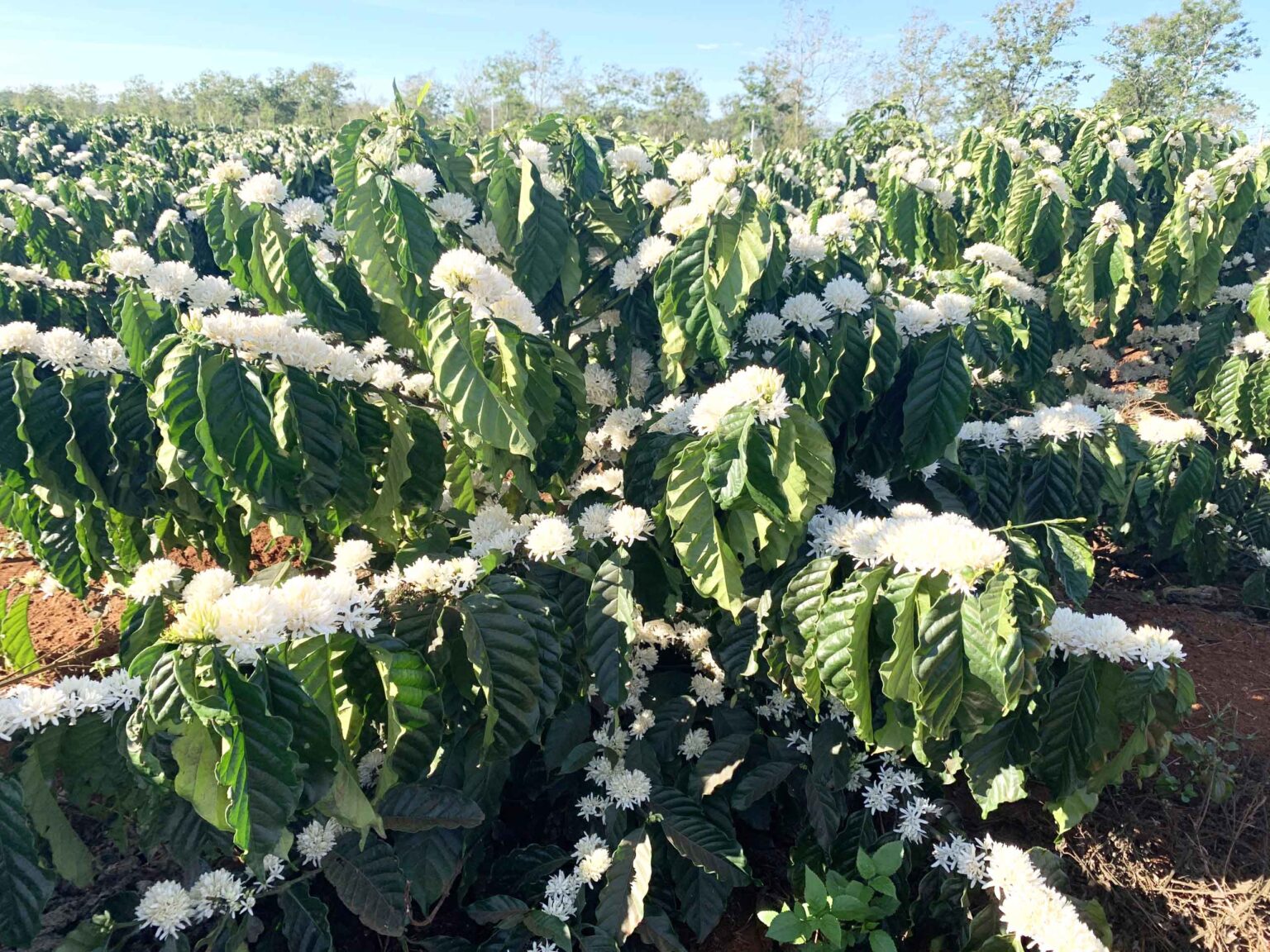
Nước, nhiệt độ và thời điểm ra hoa liên quan trực tiếp tới cây
Cây cà phê nhạy với sự thay đổi của nước và nhiệt độ trong những giai đoạn nhất định. Thiếu nước kéo dài có thể làm cây chịu stress, trong khi mưa quá mức có thể ảnh hưởng rễ, đất, bệnh và khả năng làm việc ngoài đồng. Thời điểm mưa cũng quan trọng vì nó liên quan đến ra hoa, phát triển quả và lịch thu hoạch.
Tác động không chỉ là “năng suất tăng hay giảm”. Nếu mưa đến sai thời điểm, cây có thể ra hoa không đồng đều hoặc lịch thu hoạch thay đổi. Vì vậy, cùng một tổng lượng mưa nhưng phân bố theo thời gian khác nhau có thể tạo kết quả khác.
Tác động sản lượng có thể xuất hiện với độ trễ
Một đợt thời tiết bất lợi xảy ra trước thu hoạch có thể ảnh hưởng trực tiếp tới lượng và chất lượng quả. Nhưng một tác động ở giai đoạn ra hoa hoặc phát triển quả có thể chỉ được nhìn thấy rõ ở thời điểm thu hoạch nhiều tháng sau. Điều này khiến việc liên hệ một biến động sản lượng với một hiện tượng khí hậu cần có mốc thời gian phù hợp.
Trong thị trường cà phê, độ trễ còn quan trọng vì hàng được thu hoạch, sơ chế, lưu kho và xuất khẩu theo mùa. Thị trường có thể phản ứng trước khi sản lượng thực tế xuất hiện nếu người mua kỳ vọng thời tiết sẽ ảnh hưởng vụ tới. Ngược lại, một thiệt hại tại vùng trồng có thể chưa phản ánh ngay vào dữ liệu xuất khẩu.

Chất lượng và sau thu hoạch cũng chịu ảnh hưởng
Mưa trong thời gian thu hoạch có thể làm việc hái, phơi và bảo quản khó hơn. Độ ẩm của quả và điều kiện môi trường ảnh hưởng tốc độ làm khô, nguy cơ lên men ngoài kiểm soát và chất lượng vật chất nếu quy trình sau thu hoạch không được điều chỉnh. Những tác động này khác nhau theo phương pháp sơ chế và hạ tầng của từng vùng.
Vì vậy, tác động khí hậu không kết thúc khi quả rời cây. Nếu hậu cần bị gián đoạn bởi thời tiết, lịch vận chuyển cũng có thể thay đổi. Nhưng mức độ ảnh hưởng phụ thuộc địa hình, cơ sở hạ tầng và khả năng dự phòng của chuỗi cung ứng.
Khi nhiều vùng cùng chịu tác động, thị trường mới có thể phản ứng mạnh
Giá cà phê quốc tế không phản ứng với thời tiết của một vùng theo một công thức cố định. Nếu một vấn đề chỉ xảy ra ở một vùng nhỏ và nguồn cung từ nơi khác có thể bù đắp, ảnh hưởng thị trường có thể hạn chế. Nếu nhiều vùng sản xuất lớn cùng gặp điều kiện bất lợi, kỳ vọng về nguồn cung và tồn kho có thể thay đổi đáng kể.
Ngoài thời tiết, thị trường còn nhìn vào nhu cầu tiêu dùng, tồn kho, tỷ giá, hậu cần và hoạt động mua bán. Vì vậy, El Niño hoặc La Niña có thể là một yếu tố trong biến động giá nhưng không nên được dùng làm nguyên nhân duy nhất.
Dữ liệu địa phương quan trọng hơn việc chỉ nhìn tên hiện tượng
Để đánh giá tác động thực tế, cần kết hợp dự báo khí hậu với dữ liệu mưa, nhiệt độ, độ ẩm đất, thời điểm ra hoa, năng suất và tình hình thu hoạch của vùng cụ thể. FAO cũng xem khí hậu và khả năng chống chịu của sinh kế là những vấn đề quan trọng đối với chuỗi cà phê.
Cách đọc thận trọng là đi theo chuỗi: khí hậu thay đổi thế nào; cây phản ứng ra sao; sản lượng hoặc chất lượng thay đổi khi nào; nguồn cung và hậu cần chịu tác động thế nào; rồi thị trường phản ánh ra sao. Chuỗi này giúp tránh biến một tín hiệu khí hậu thành một dự báo giá đơn giản.
Tác động khí hậu không nhất thiết đi cùng một hướng với giá
Nếu El Niño làm giảm nguồn cung tại một vùng nhưng các vùng khác có mùa vụ tốt, tổng cung thế giới có thể không giảm tương ứng. Ngược lại, một vấn đề ở nhiều vùng cùng lúc có thể làm thị trường nhạy cảm hơn với tin thời tiết. Tồn kho và khả năng thay thế giữa các nguồn gốc cũng ảnh hưởng mức phản ứng. Ngoài sản lượng, chất lượng và hậu cần có thể tạo những tác động riêng. Mưa trong thời gian phơi có thể làm tăng rủi ro xử lý sau thu hoạch, nhưng mức độ ảnh hưởng phụ thuộc vào hạ tầng và phương pháp sơ chế. Vì vậy, cùng một hiện tượng khí hậu có thể tạo tác động kinh tế khác nhau giữa hai vùng sản xuất.
Thời tiết còn ảnh hưởng tới thời điểm giao hàng
Nếu mưa lớn hoặc điều kiện đường sá bất lợi làm chậm thu hoạch và vận chuyển, lịch đưa cà phê ra khỏi vùng sản xuất có thể thay đổi. Với những hợp đồng có lịch giao cụ thể, độ trễ này có thể ảnh hưởng tới kế hoạch hậu cần và tồn kho. Nhưng mức độ ảnh hưởng phụ thuộc khả năng dự phòng của từng chuỗi cung ứng, nên không thể suy ra từ hiện tượng khí hậu alone.
Tài liệu tham khảo
- NOAA, El Niño and La Niña — https://www.noaa.gov/education/resource-collections/weather-atmosphere/el-nino
- FAO, Coffee: Markets and Trade — https://www.fao.org/markets-and-trade/commodities-overview/beverages/coffee/en
- ICO, Báo cáo thị trường cà phê — https://ico.org/resources/coffee-market-report-statistics-section/
El Niño and La Niña Do Not Produce the Same Weather Everywhere
El Niño and La Niña are phases of a large-scale climate pattern, but neither should be treated as a universal weather script. Their effects vary by region and season. A coffee-producing country may experience warmer or wetter conditions during one phase while another producing area experiences a different combination of temperature and rainfall. The useful analytical unit is therefore not the name of the climate pattern alone, but the local weather anomaly that follows from it. For coffee, that means asking what happens to rainfall, temperature, soil moisture, and the crop calendar in the producing area being studied. A climate signal can be meaningful without being uniform. Treating it as uniform is what creates many of the misleading claims about its effect on coffee.
Water, Temperature, and Flowering Timing Directly Affect the Crop
Coffee plants respond to water and temperature through biological processes that depend on timing. Flowering, fruit set, fruit development, and maturation each have different environmental requirements. A rainfall deficit during one stage may matter differently from the same deficit after harvest, while excessive rainfall near flowering or harvesting can create different operational problems. Temperature also interacts with water availability, so a warm period is not interpreted in isolation from soil moisture and recent rainfall. The key is to connect the large-scale climate signal with the actual conditions experienced by the crop. This is why local observations, agronomic information, and regional weather data are necessary even when the initial market story begins with a global climate index.
Production Effects Can Appear with a Lag
The production effect of a climate pattern may not appear immediately. A weather anomaly can alter plant development first and only later become visible in yield or crop progress. The delay can be even longer when damage affects branches, flowering potential, or the next production cycle. This lag matters for market analysis because prices can respond to expectations before official production statistics change. It also means that a current weather report and a future production estimate are not interchangeable pieces of information. Analysts need to distinguish what is already observed from what is expected to happen later and identify the biological pathway connecting the two.
Quality and Post-Harvest Handling Can Also Be Affected
Weather can affect quality and post-harvest operations as well as yield. Rain during harvesting can complicate picking, drying, storage, and transport. Excess moisture can increase operational difficulty, while prolonged dryness can influence fruit development. These effects are not automatic and cannot be inferred solely from a climate label. The actual outcome depends on farming systems, infrastructure, harvest timing, processing method, and local conditions. For the market, this distinction matters because a weather event may affect shipment timing or quality differentials without producing a large change in total national output. A complete analysis therefore considers both quantity and the condition and movement of the physical coffee.
A Strong Market Response Requires More Than One Affected Region
A large market response is more plausible when a climate-related disturbance affects a substantial share of globally important supply and when other sources cannot easily offset it. If only one small region is affected, inventories or alternative origins may absorb much of the impact. If several important producing areas experience adverse conditions at the same time, the global balance can become more sensitive. Even then, the price response depends on demand, stocks, trade flows, and expectations. The market does not price a climate phenomenon in the abstract; it prices the expected consequences for available coffee.
Local Data Matter More Than the Name of the Climate Pattern
Local evidence is therefore more useful than simply repeating the name of El Niño or La Niña. A market reader should look at rainfall and temperature anomalies, crop stage, soil moisture, field reports, production estimates, and logistics. This helps distinguish a broad climate signal from an actual supply disruption. The same discipline also prevents a climate event from being used as a one-line explanation for every price movement. If local conditions do not show a meaningful production or logistics effect, the climate headline may have limited relevance to the physical coffee balance.
Climate Effects Do Not Necessarily Move Prices in One Direction
Climate effects do not determine price direction on their own. A weather-related production concern can be bullish when it reduces expected supply, but the same period can coincide with stronger production elsewhere, high inventories, weak demand, or a market that had already priced the risk. Conversely, favorable weather can reduce a supply concern without producing a large price decline if other forces dominate. Delivery timing is another channel: rain, heat, or infrastructure disruption can delay harvest, processing, transport, or exports even before the total crop estimate changes. The sound conclusion is therefore conditional: climate patterns can influence coffee through multiple physical channels, but their market effect must be established from local evidence and the wider balance. One practical implication is that climate analysis should be regional from the beginning. A global index can identify a background condition, but the market needs evidence about the producing areas that matter for the relevant crop cycle. Rainfall anomalies, temperature observations, soil moisture, flowering reports, and crop estimates provide a more direct bridge between climate information and coffee supply. Without that bridge, a discussion of El Niño or La Niña remains too general to support a production conclusion. The lag between weather and production also creates room for expectations to move ahead of physical statistics. Traders may respond to a credible risk before the crop outcome is known, while commercial participants may change purchasing or delivery plans as conditions evolve. Later information can reverse the initial view. This is why a climate-related market analysis should distinguish the information available at each stage instead of treating the final outcome as if it had been known from the beginning. For a broader market assessment, climate should be combined with stocks, trade, demand, and conditions in other origins. A production concern in one country can be offset by a favorable crop elsewhere, while a logistics disruption can matter even without a major change in total production. The value of the climate signal comes from its interaction with the physical coffee system, not from the climate label alone. The practical lesson is to use the climate pattern as a starting hypothesis rather than a finished explanation. Once the regional weather response is known, the analyst can examine crop stage, soil moisture, flowering, production estimates, and logistics. This makes it possible to distinguish a climate signal that matters physically from one that is mainly a media or market narrative. It also allows the analysis to evolve as observations replace forecasts. In that sense, the most useful climate analysis is dynamic: it begins with a broad signal, narrows to producing regions, and then tests the expected consequences against actual crop and trade information. For professional analysis, the most useful habit is to keep the causal chain visible. Start with the observable condition, identify the mechanism through which it can affect coffee, and then state which additional evidence is needed before drawing a market conclusion. This avoids confusing a background variable with a direct price driver. It also makes the analysis easier to update when new information arrives. In practice, the same discipline means recording the relevant time period, defining important terms, and distinguishing observed data from forecasts or interpretations. A careful reader should be able to see where the source evidence ends and where analytical judgment begins. That boundary is especially important in coffee because physical production, trade, finance, weather, and consumer behavior interact across different time horizons. A concise market statement can therefore be useful, but only when its assumptions and evidence remain traceable. That discipline is what allows a conclusion to remain useful after the market environment changes. It also makes the reasoning easier to compare with later evidence, because the reader can see which observation changed, which assumption changed, and which part of the conclusion remains supported. In a professional research workflow, this traceability is as important as the conclusion itself. A well-structured article should leave enough context for a later reader to understand the evidence without reconstructing the original analysis from memory. This is the difference between a plausible story and an analysis that can withstand comparison with later data. Overall.
Weather Can Also Change the Timing of Deliveries
Delivery timing can be an important practical consequence even when the eventual crop estimate changes only modestly. Weather can delay harvesting, drying, inland transport, loading, or export operations, changing when coffee becomes available to buyers. A market may therefore experience a temporary tightening in physical availability without a proportional change in total production. This distinction is useful because price, shipment timing, and crop size can respond on different schedules.
References
- NOAA, El Niño and La Niña — https://www.noaa.gov/education/resource-collections/weather-atmosphere/el-nino
- FAO, Coffee: Markets and Trade — https://www.fao.org/markets-and-trade/commodities-overview/beverages/coffee/en
- ICO, Coffee Market Report — https://ico.org/resources/coffee-market-report-statistics-section/